

RDNA 2 deep-dive: What’s inside AMD’s Radeon RX 6000 graphics cards - thaxtonationvin
RDNA 2. The graphics architecture at the heart of AMD's kick-ass fres Radeon RX 6000 graphics cards English hawthorn dependable like a reniform iteration upon the originative "RDNA" GPUs that came before it, but RDNA 2—which also powers the next-gen Xbox Series X and PlayStation 5 consoles—is much more than a mere refresh. Significant tweaking has resulted in a surprising 54-percentage increase in top executive-per-W concluded AMD's last-gen Radeon RX 5000 GPUs. Perhaps more notably, the Radeon RX introduces an innovative new "Infinity Hive up" technology that reimagines how computer memory behaves in artwork cards. Oh, and shaft of light tracing? AMD does that now, to a fault.
Add IT all up, and the Radeon RX 6800-series nontextual matter debuting today bring off to challenge Nvidia's enthusiast-class gaming flagships first in a long time. Head ended to our Radeon RX 6800 and RX 6800 XT inspection to see what that means in practical footing. This high-level overview of the RDNA 2 architecture bequeath help you explain how AMD achieved it complete.
RDNA 2 computer architecture changes
 AMD
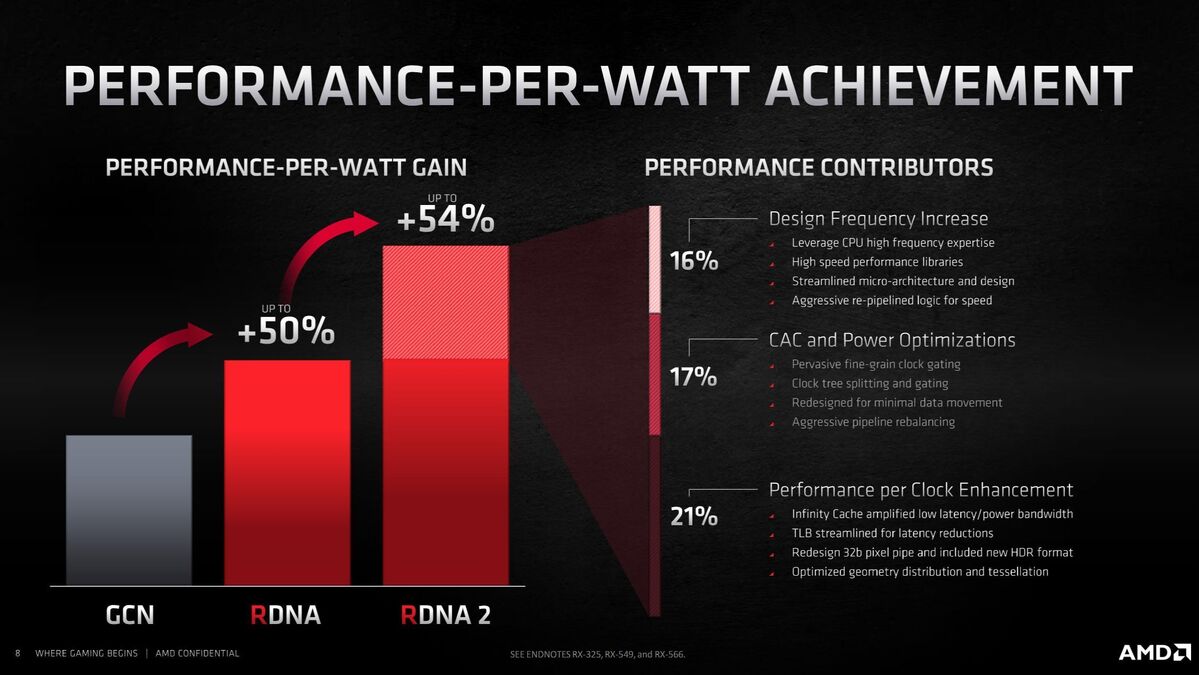
AMD AMD's engineers approached RDNA 2 with sublime efficiency goals as their guiding lights. The creative RDNA architecture provided a 50-per centum carrying out-per-James Watt increase over its "GCN"-based predecessors, finally matching Nvidia's vaunted top executive efficiency, and the company's executives wanted RDNA 2 to keep that pace. Spoiler alert: They did. It took a lot of hard go though, as healed as close collaboration with the Ryzen CPU architecture team up, because RDNA 2 is built using the same TSMC 7nm manufacturing process as RDNA 1. A big part of the original RDNA's efficiency gains came from the thickening leap from 14nm to 7nm, but RDNA 2's improvements required more than substantial tweaking.
 AMD
AMD 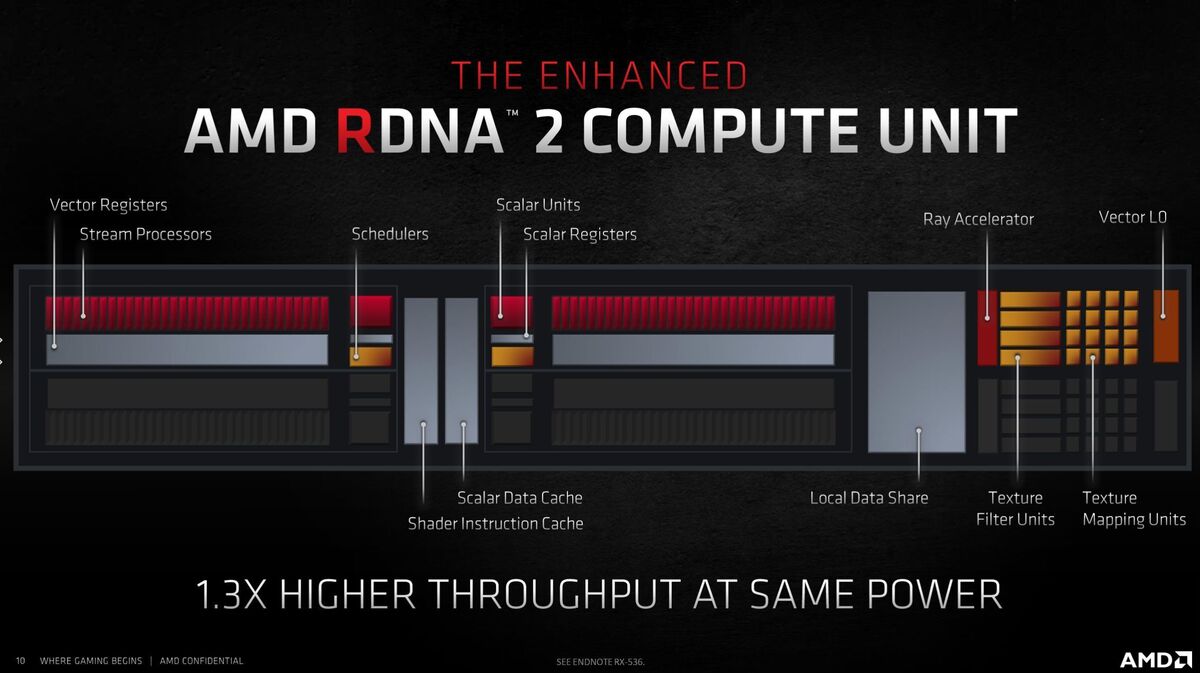 AMD
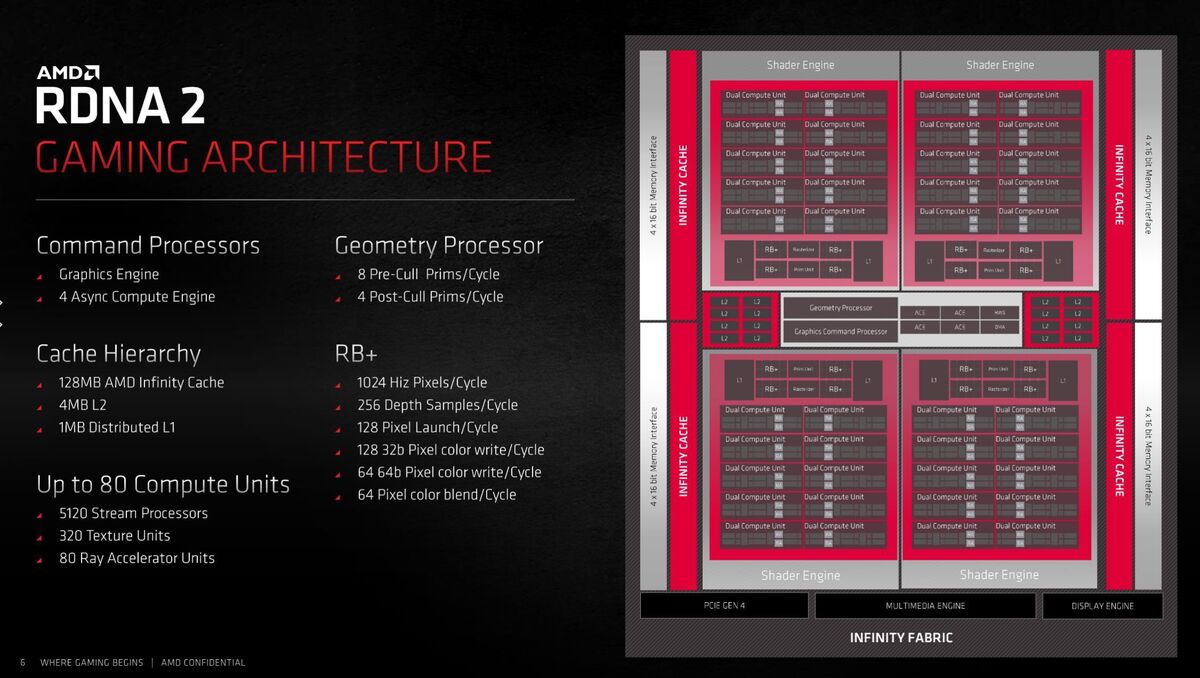
AMD Despite the intense rejiggering, the fundamental RDNA 2 building blocks remain mostly similar to RDNA 1's in broad strokes—aside from the gain of dedicated ray accelerator hardware, which we'll get to later—only armored up much further.
 AMD
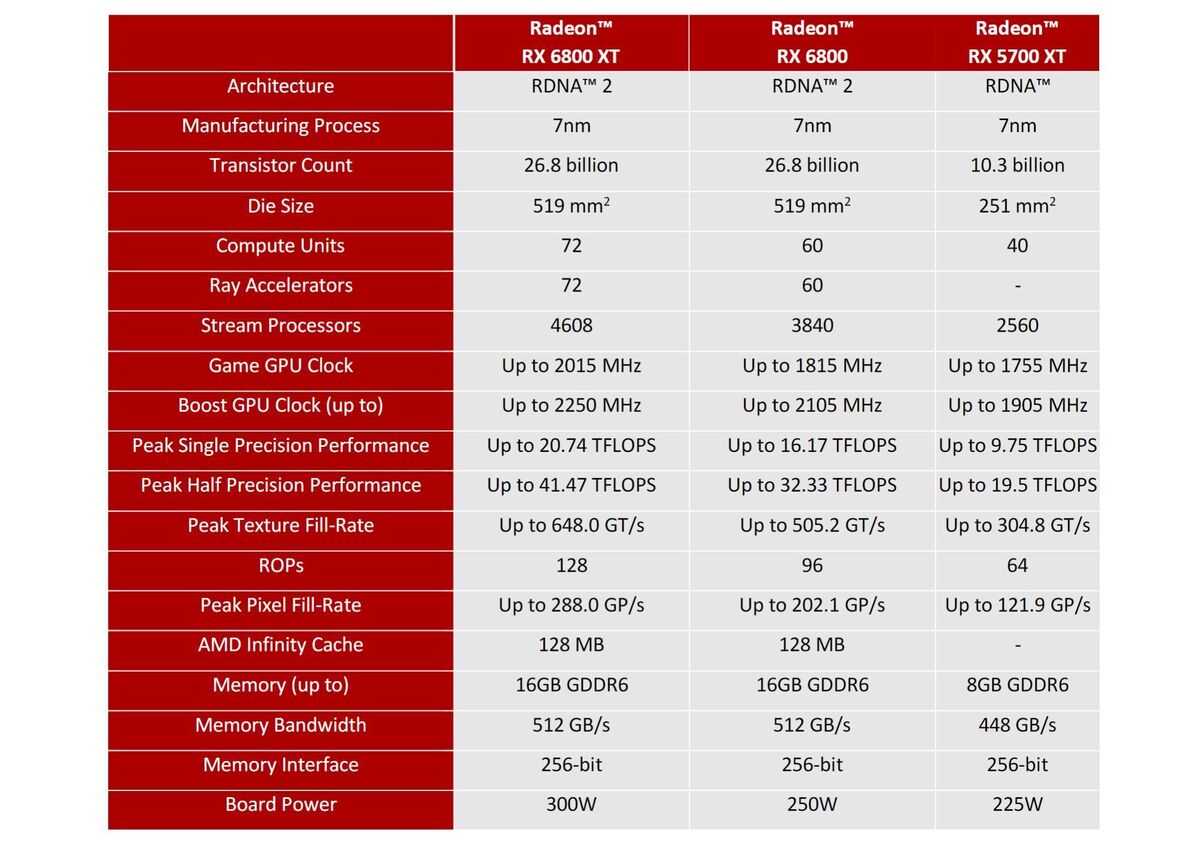
AMD AMD stayed modest with last generation's RDNA 1 products. Its flagship, the Radeon RX 5700 Crosstalk, topped extinct at 40 compute units and 10.3 one thousand million transistors inside its 251mm² die—a surprise considering AMD's previous GCN architectures scaled busy 64 CU designs. (We'll engender to why that was later as recovered.) RDNA 2 blows well early that. The $579 Radeon RX 6800 includes 60 CUs, the $649 Radeon RX 6800 XT ups that to 72 CUs, and the flagship $999 Radeon RX 6900 XT will fully double-up last coevals's RX 5700 XT with a whopping 80 CUs deep down a massive 519mm² die with over 26 billion transistors. By contrast, the "Ampere" GPU die inside Nvidia's rival $1,500 GeForce RTX 3090 packs a hair over 28 billion transistors into a much larger 628mm² pop off.
Swiping a page from AMD's fantastic Ryzen 5000 CPUs, RDNA 2 implements distributive fine-grain clock gating to allow parts of the GPU to loosen up if they aren't being used, improving power efficiency. RDNA 2 to boot features more vigorous time Tree splitting and gating (like server CPUs) for the same reason, but Sir Thomas More parallelized to hit the higher bandwidths adequate with GPUs. The company's engineers also "sharply" rebalanced information pipelines and smooth redesigned integral data paths, honing the computer architecture for maximum efficiency. Those optimizations accounted for around a third of the adequate 54-percent performance-per-W increase delivered in the Radeon RX 6800 and 6800 XT (and the whopping 65-percentage increase secure for the flagship Radeon RX 6900 XT coming December 8).
 AMD
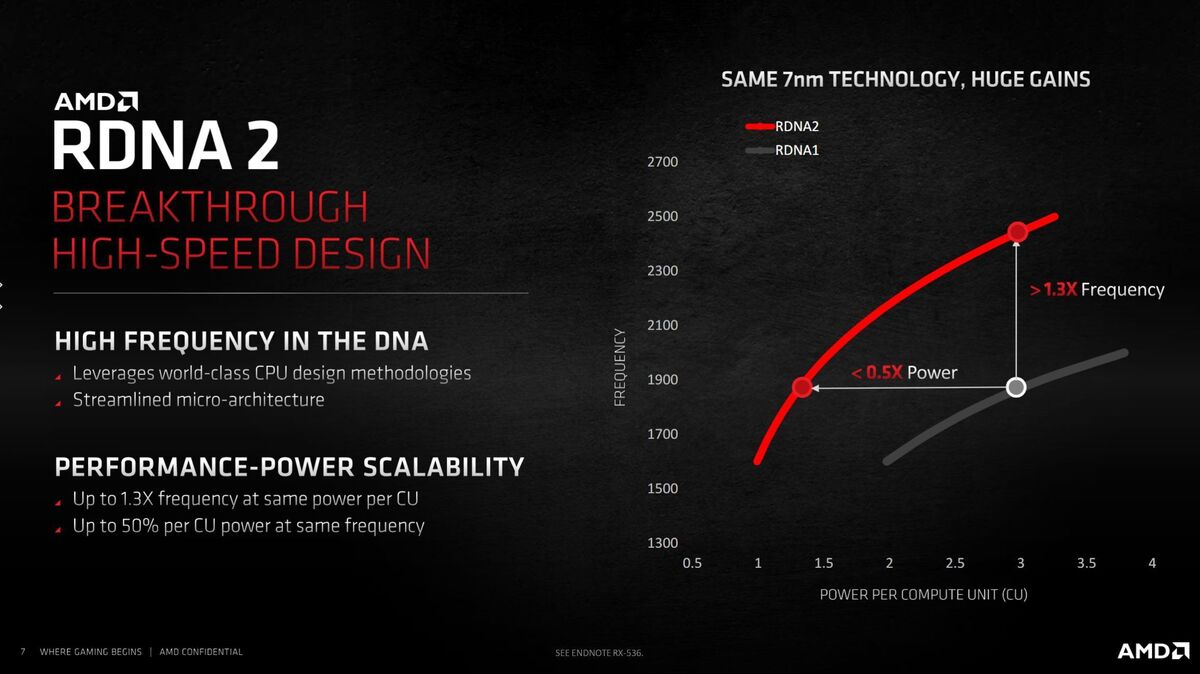
AMD Performance-per-watt isn't all about power efficiency, though—hence the word "performance." Another third of RDNA 2's perf-per-watt improvement comes from pushing the pedal to the argentiferous even harder. Once over again, AMD's engineers optimized the microarchitecture, logic, and execution libraries with a focus happening speed. The most tactual results of their efforts have to be the insane clock speeds of the Radeon RX 6000 GPUs. AMD's CPU engineers throw spent a elongated time honing speeds connected the 7nm process node by this point, and they shared their expertness with the Radeon team to great gist.
The Radeon RX 6000-serial graphics cards push well past the 2GHz barrier. Company representatives were keen to swash the "unexampled" speeds in conversations with press. They should be. All three high-ending options—the Radeon RX 6800, 6800 XT, and 6900 XT—have boost time speeds that transcend a whopping 2.1GHz. The ii XT models travel the whole way capable 2,250MHz. Those are under ideal conditions, but AMD says the XT cards hit 2,015MHz even in gaming workloads, keeping pace with Nvidia's staggeringly powerful Ampere GPUs, which can cost increase to just about 2GHz during gameplay.
AMD couldn't suffer hit much fast speeds or achieved its power efficiency goals without the introduction of RDNA 2's revolutionary Infinity Cache.
RDNA 2 Infinity Cache explained
 AMD
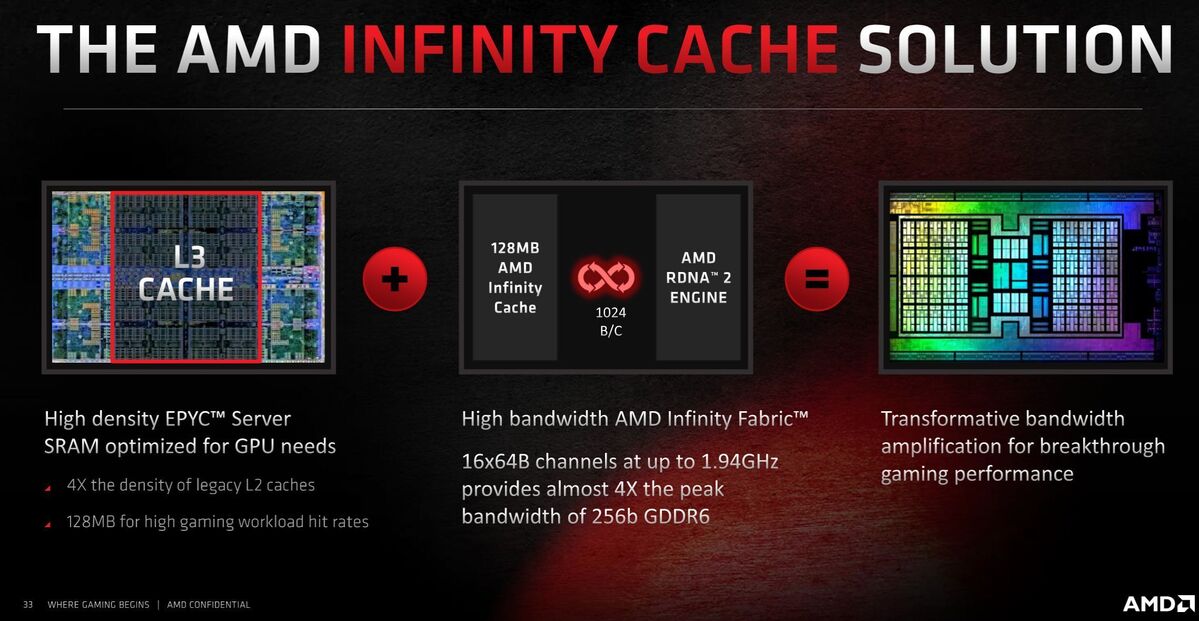
AMD RDNA 2's standout feature besides swipes a page from processor intention—Epyc server processors, in this showcase. Traditional GPUs include L1 and L2 caches of various sizes. Radeon RX 6000 graphics cards add an "Eternity Hive up" that behaves similarly to the "Game Cache" that helps modern Ryzen processors game so much better than earlier models did. Divine aside Epyc waiter CPUs, Eternity Cache is basically a massive 128MB L3 cache that has been heavily optimized for gaming workloads. It's fourfold denser than the L3 SRAM in Epyc processors to help improve tycoo efficiency, overly.
 AMD
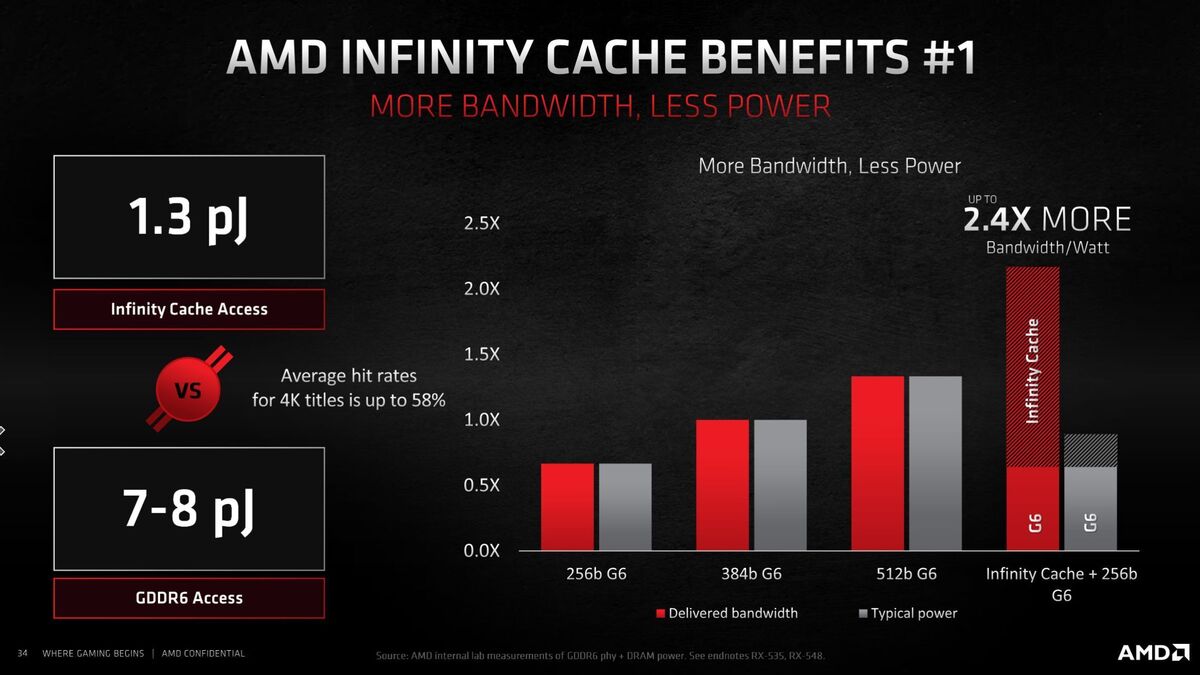
AMD Equipping the GPU with such a jumbo, high-speed cache lets information technology keep most of the working data for any given frame on-buy the farm. This saves the GPU from having to keep sending signals the whole way across the package to the 16GB of onboard GDDR6 memory in many cases, especially because the cache holds a lot of attribute and spatial data that canful be reused in subsequent frames. That makes Infinity Hive up much quicker and much more index-expeditious compared to simply progressive the bus breadth to the memory modules.
Sam Naffziger, AMD's product engineering architect, says that even though the Radeon RX 6000 GPUs stick to a modest 256-bit bus, the Infinity Cache helps RDNA 2 deliver massively more bandwidth-per-W than conventional GDDR6 equipped with plane a humongous 512-bit bus. By compare, Nvidia's rival high-end RTX 3080 and 3090 graphics cards utilize wider 320-tur and 384-bit buses, severally, paired with slip-edge GDDR6X retentiveness that uses "PAM4" signaling engineering, which lets them get off four possible values per cycle, upfield from the traditional two. That lets GDDR6X move data at twice the rate of GDDR6, merely with higher latency and power demands.
 AMD
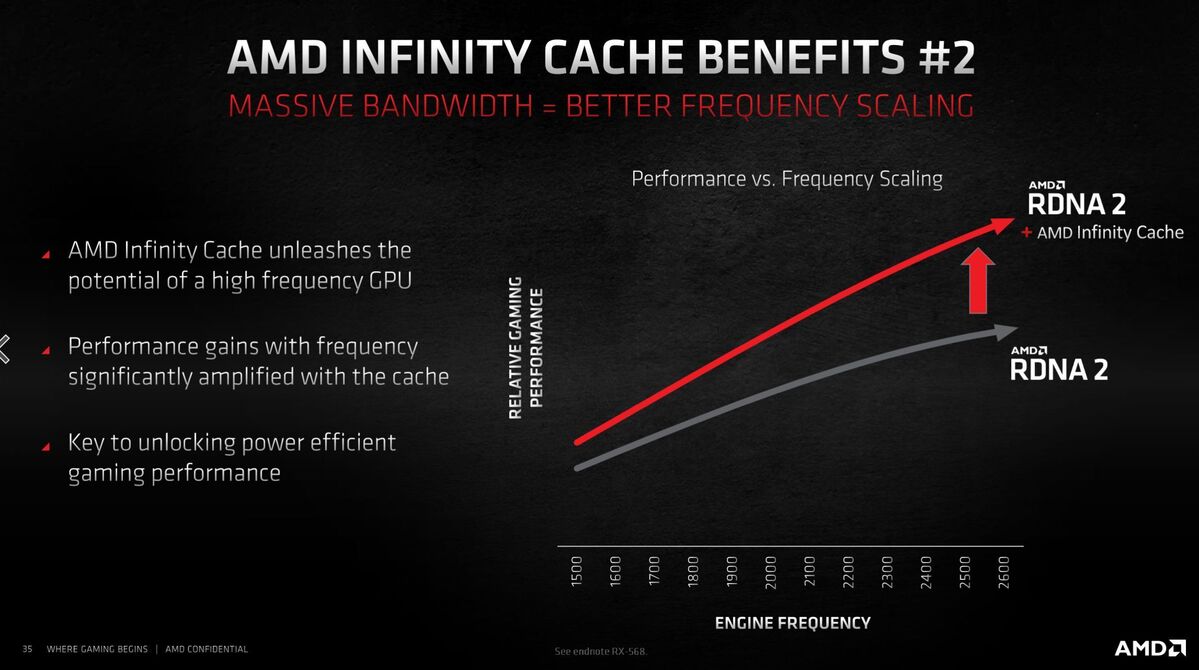
AMD The Eternity Cache also helps enable RDNA 2's sky-high clock speeds. If AMD had time-tested to force the original RDNA memory subsystem on RDNA 2, Naffziger said, it would have required a massively large memory configuration to avoid starving the GPU for bandwidth. That would have required upgrading to immense 512-bit buses, and more, quicker memory, all of which would sustain sent the baron demands skyrocketing—a no-go given RDNA 2's design goals.
The overwhelming bandwidth enabled away Infinity Cache keeps RDNA 2's CUs fully fed, as you rear end see in the chart preceding. When AMD's engineers disable Infinity Cache in their labs and regress to the standard cache design with 16GB of GDDR6 retentiveness over a 256-bit bus, GPU clock frequencies come disconnected a cliff.
 AMD
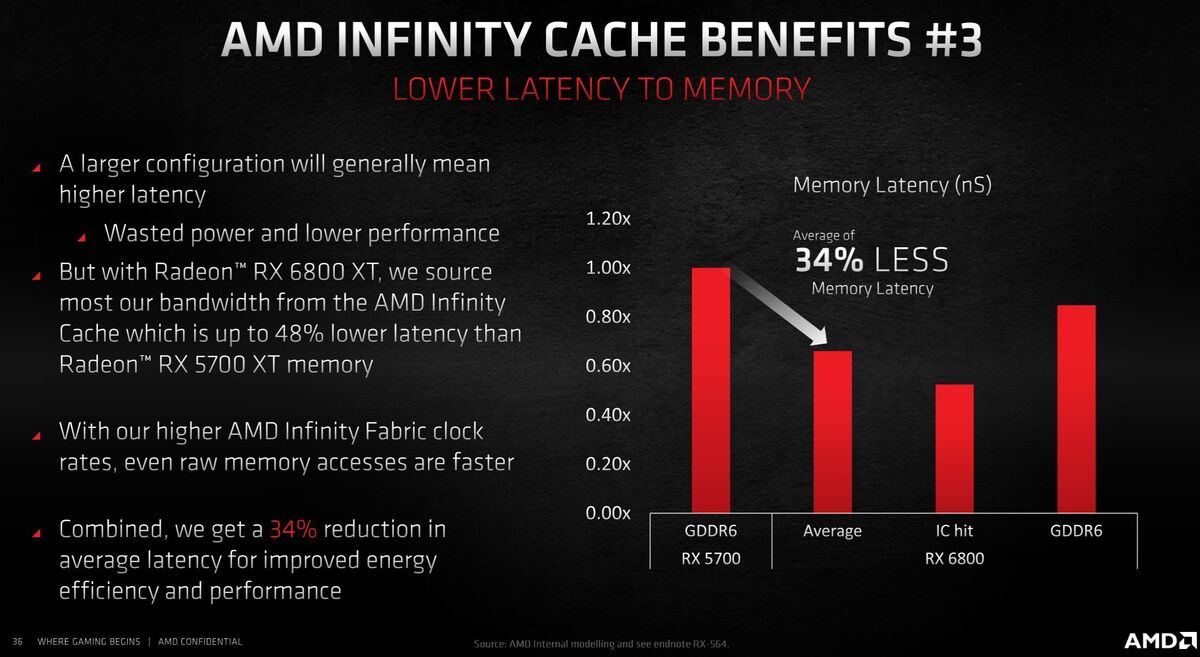
AMD By holding thusly much human body information on die, the Eternity Cache helps the Radeon RX 6800 average 34 percent less latency than the older Radeon RX 5700 XT. When a scene fully "hits" the Infinity Cache, the latency reduces promote. Naffziger says that AMD's Infinity Fabric communication technology can scale its speeds upwardly and down to optimize efficiency, ramping raised to 550GB/s when the Infinity Stash becomes especially stressed. But even when the GPU needs to access your circuit card's actual VRAM, latency also improves compared to the survive-gen Radeon card game thanks to a general speed increase for Infinity Material.
 AMD
AMD AMD tuned the Infinity Hoard connected this initial terzetto of enthusiast-course cards for 4K gaming, which is why it's configured with an impressive 128MB. Naffziger says the large size lets Infinity Cache achieve a 56 percentage "hit rate" crosswise a wide range of titles at 4K resolution, and higher off rates as the resolution scales down. Divide of the reason why these cards perform better than their Nvidia competition at 1440p gaming is attributable tenor Eternity Cache polish off rates, AMD's Laura Smith said.
But the Infinity Memory cache performance doesn't weighing machine linearly Eastern Samoa closure decreases, Naffziger warned. When you drop to 1080p, games ofttimes become much Processor- surgery engine-conjugated than memory-jump on. (I wouldn't be surprised if more affordable Radeon RX 6000 offerings in the future decreased the Infinity Cache's size because of that.)
As wel, the Infinity Cache spreads its wings the most in applications that are Thomas More memory-bound, though its benefits can be felt even when a crippled needs to get at traditional VRAM more frequently. Naffziger says in those cases, RDNA 2's whole retention system behaves rough happening a par with what you'd see to it if you'd well-appointed these card game with a 512-snatch bus.
Eternity Cache greatly helps with radiate tracing too.
Ray trace with RDNA 2
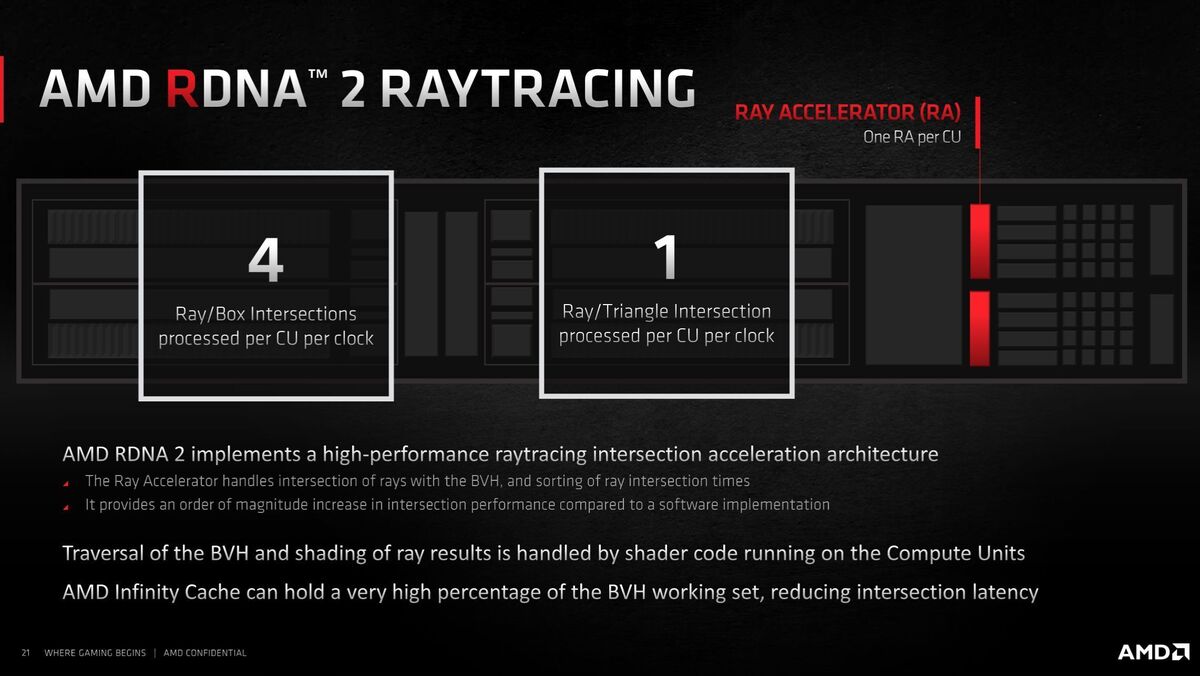
Yes, AMD's Radeon GPUs can care real-prison term ray trace now. Nvidia kicked sour the ray tracing party by adding dedicated "RT cores" for handling beam trace to its senior RTX 20-series GPUs. Now AMD is joining the fun by adding a solitary consecrate "ray gas" to each RDNA 2 compute social unit. That means as you go up the Radeon RX 6000 stack, more powerful graphics card game with more compute units volition also be break at ray trace, Eastern Samoa they'll have more sacred ray trace hardware.
 AMD
AMD Arsenic you can see in our Radeon RX 6800 and 6800 XT recapitulation, RDNA 2 isn't quite connected a par with Nvidia's second-gen ray tracing effectuation. IT yet delivers astonishingly good ray tracing performance, achieving real playable frame rates at both 1440p and 1080p resolution. You won't be competent to play games at 4K with the intensive firing technologies enabled, however, and AMD says it targeted 1440p gaming as its ray tracing goal. Away and large, it delivered.
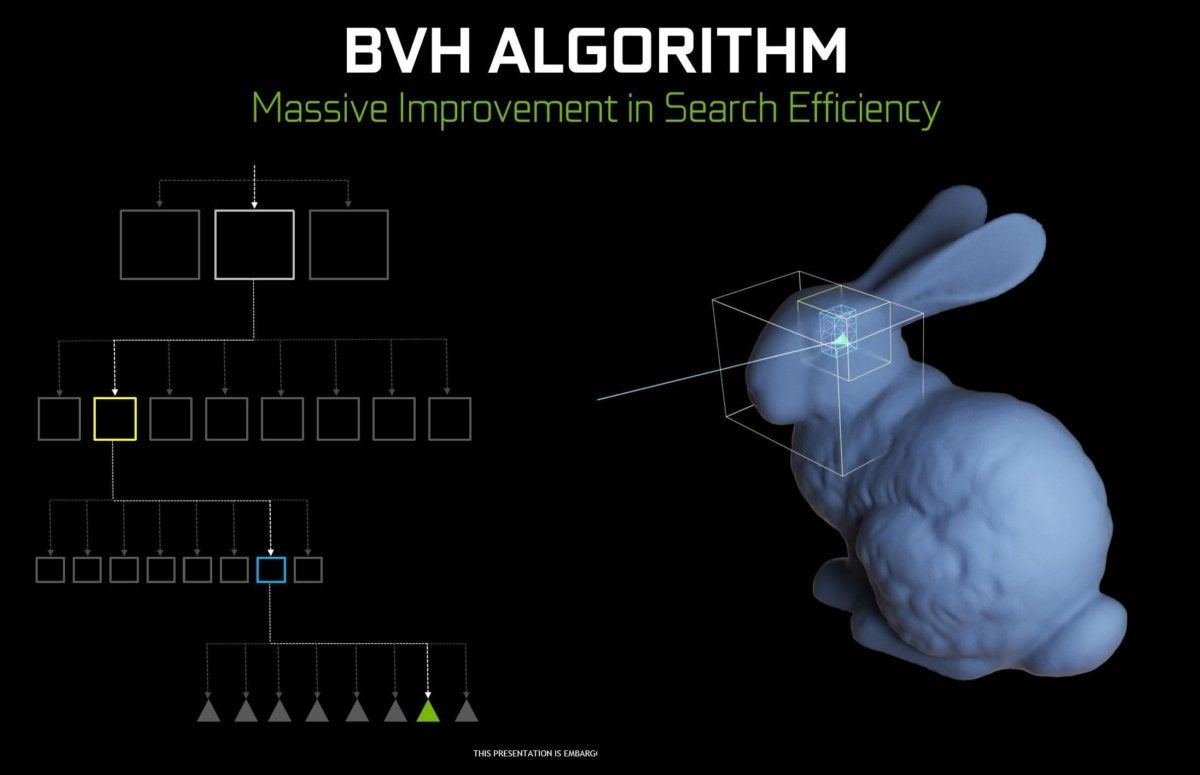
Infinity Cache comes through in the clutch here, too. We delved deeper into how ray tracing works in our innovational deep-diving of Nvidia's Alan Mathison Turin architecture, where the technology debuted, but basically information technology works by having dedicated ray tracing ironware perform calculations of how the unaccented rays behave, using a technique renowned as bounding mass hierarchy (BVH) traversal. Performing that task is very memory-intensive, which is wherefore VRAM demands leap upward when you enable ray tracing in a game.
 Nvidia
 Nvidia's BVH algorithim for shaft tracing
AMD says it's capable to keep "a real top percentage of the BVH working set" directly inside the Infinity Hoard, reduction latency and improving overall execution. The irradiatio accelerator handles intersections in the BVH, while RDNA 2 uses standard shader code in the figure units for ray transversal and shading the actual scene.
That same, AMD does not have an answer for Nvidia's Colourful Learning A-one Sample distribution (DLSS) applied science. Ray tracing is incredibly computationally dearly-won, and activating it creates a impressive operation impact. To counteract the loss in frame rate, DLSS renders games at a glower resolution, and so upscales the final image to your game result using simple machine learning to spiff ascending the persona, all battery-powered past Nvidia's dedicated Three-toed sloth-centered tensor cores.
Early iterations of DLSS could look like Vaseline smeared on your screen, just the DLSS 2.0 technology rolling out in newer games works like black magic. It's wonderful, and truly makes flipping ray tracing along to a lesser extent painful. The tensor cores also wield "denoising" when ray tracing is connected to avoid a gamey look common on older, inferior advanced ray tracing implementations.
 AMD
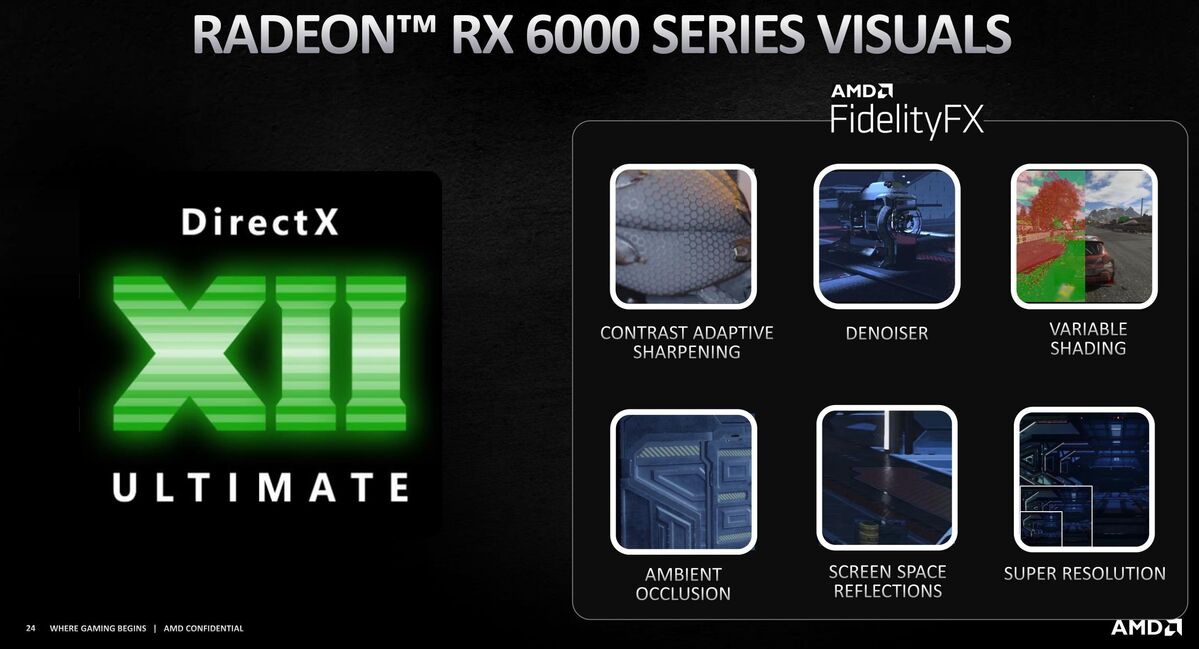
AMD You can see the mysterious "Tiptop Resolution" listed here.
AMD doesn't include dedicated AI upscaling computer hardware in RDNA 2. Denoising is handled aside the full general reckon units, and it workings very well by my eye—just there's no DLSS-like sport to claw posterior lost frames. During its Radeon RX 6000 reveal, AMD excited some kind of DLSS rival dubbed "Super Resolution" as part of its FidelityFX suite of ASCII text file tools without going into detail. Representatives declined to say to a greater extent, other than to say that Comprehensive Resolution will not constitute in stock immediately. That said, because AMD's RDNA 2 powers both adjacent-gen consoles as fortunate, the companion hopes its open-source alternative winds up gaining traction with developers when information technology does arrive. The companion's FidelityFX toolkit also includes a denoiser solution that developers can follow up.
DirectX 12 Ultimate features and many
But wait, in that location's more. Wish Nvidia's Holocene epoch RTX-proprietary GPUs, RDNA 2 is fully DirectX 12 Ultimate-compliant. Microsoft calls DX12 "a force multiplier for the entire gambling ecosystem" by unifying an array of new features—generally ones introduced in Nvidia's Turing-based RTX 20-series, but largely ignored by developers—across all modern Microcomputer and next-gen Xbox Series X ironware.
 AMD
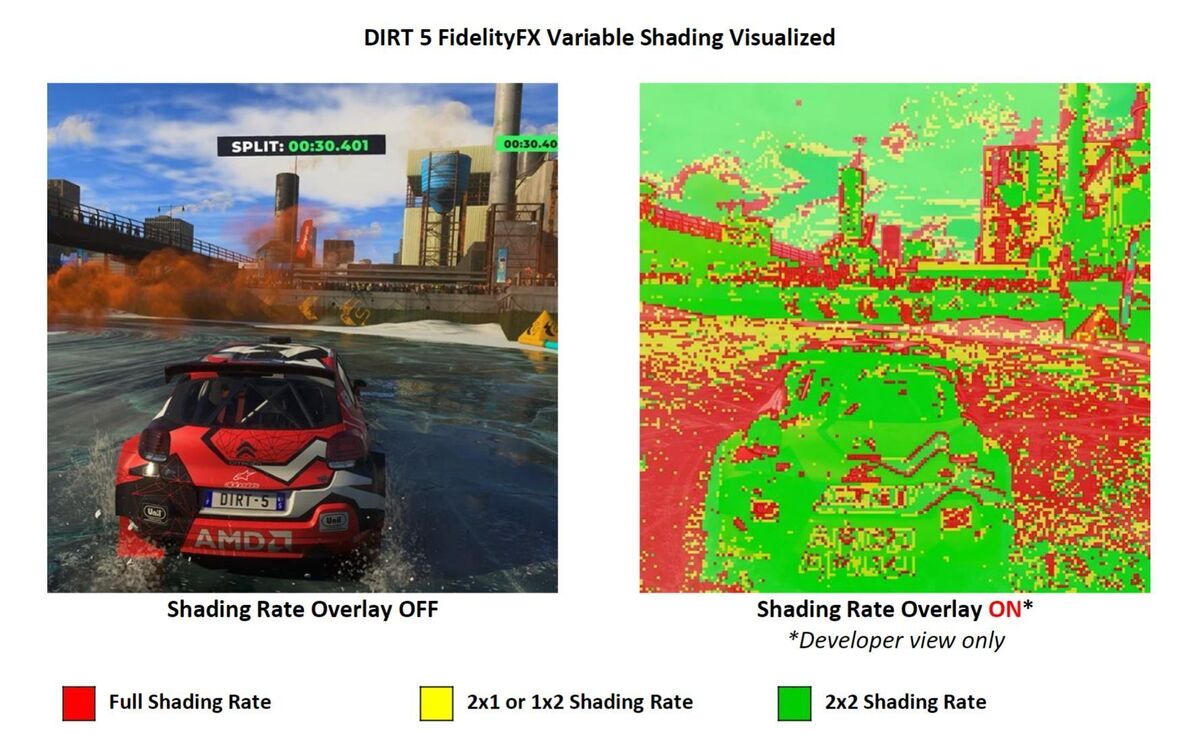
AMD That means Radeon RX 6000-series art cards likewise get wind nifty tricks ilk mesh shading, varied rate blending, and sampler feedback, which we covered in our look at DirectX 12 Ultimate. All of the features hold great potential to better some functioning and visual faithfulness. AMD optimized various parts of RDNA 2 around them, such every bit improving the tinge compaction behavior and adding consecrate sampler feedback logic.
AMD's Radeon GPUs leave also support Microsoft's DirectStorage API when it debuts in 2021 (as volition Nvidia's RTX 30-serial). DirectStorage lets your NVMe SSD talk now to your artwork plug-in's remembering for vastly improved consignment and plus-streaming performance. Here's how DirectStorage aims to stamp out crippled-loading multiplication connected the Personal computer. It has the potential to atomic number 4 a real number game-changer.
 AMD
AMD Other aspects of RDNA 2 received upgrades as swell. The display engine now supports HDM1 2.1, e.g.. The multi-media engine tail handle AV1 decoding for 8K videos and includes a high-quality 8K HEVC encode accelerator, matching advancements plant in Nvidia's Ampere GPUs. 8K is the most niche of niche cases at this distributor point, though, and this is acquiring long enough.
Be predestined to chink out our full Radeon RX 6800 and RX 6800 XT review to see how all these RDNA 2 improvements translate into graphics cards you can in reality corrupt. They're fantastic, and they truly challenge Nvidia's high-end gaming options for the first time since 2013's Radeon R9 290X hit the streets. Whatever else you can say about 2020, it's a great year to live a gamer.
Source: https://www.pcworld.com/article/393733/rdna-2-deep-dive-inside-amd-radeon-rx-6000-graphics-cards.html
Posted by: thaxtonationvin.blogspot.com
0 Response to "RDNA 2 deep-dive: What’s inside AMD’s Radeon RX 6000 graphics cards - thaxtonationvin"
Post a Comment